Behind Sofa Table Size Guide: Height, Length & Depth Explained
A practical, design-forward guide to choosing the right behind‑sofa table. Learn how tall the table should sit relative to your sofa back, how long and how deep it should be (with 20 / 25 / 30 cm depth examples), how much circulation clearance to allow, when to ask for a custom size, and simple measurement steps for sofas 180–240 cm long.
Introduction — what this guide covers
A narrow table behind a sofa is a simple way to add surface area, lamps, plants and a finishing touch to a living room. This guide focuses on practical sizing: height, length and depth, plus circulation and styling considerations. You’ll find rules of thumb, examples for common sofa widths (180–240 cm), and notes on when a custom size is worth ordering.
What’s the difference: behind‑sofa table, sofa table and console table?
Terminology overlaps in interiors. In this article we use: - "Behind‑sofa table" or "behind‑couch table" for a narrow table placed directly behind a sofa; - "sofa table" as a general term for a slim table used behind or alongside seating; - "console table" as a slightly wider category that can stand against a wall or behind furniture. The same sizing principles apply, but placement and function influence the best depth and length.
How tall should a behind‑sofa table be?
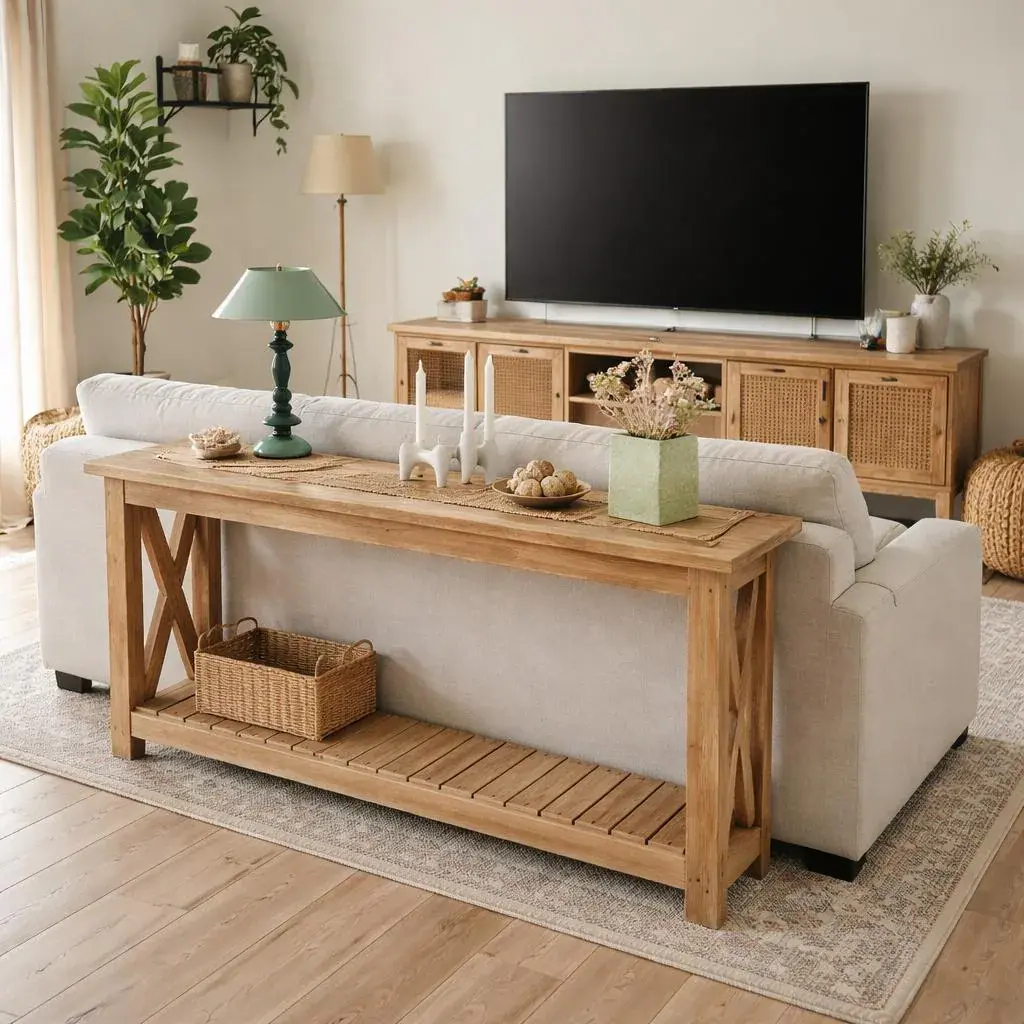
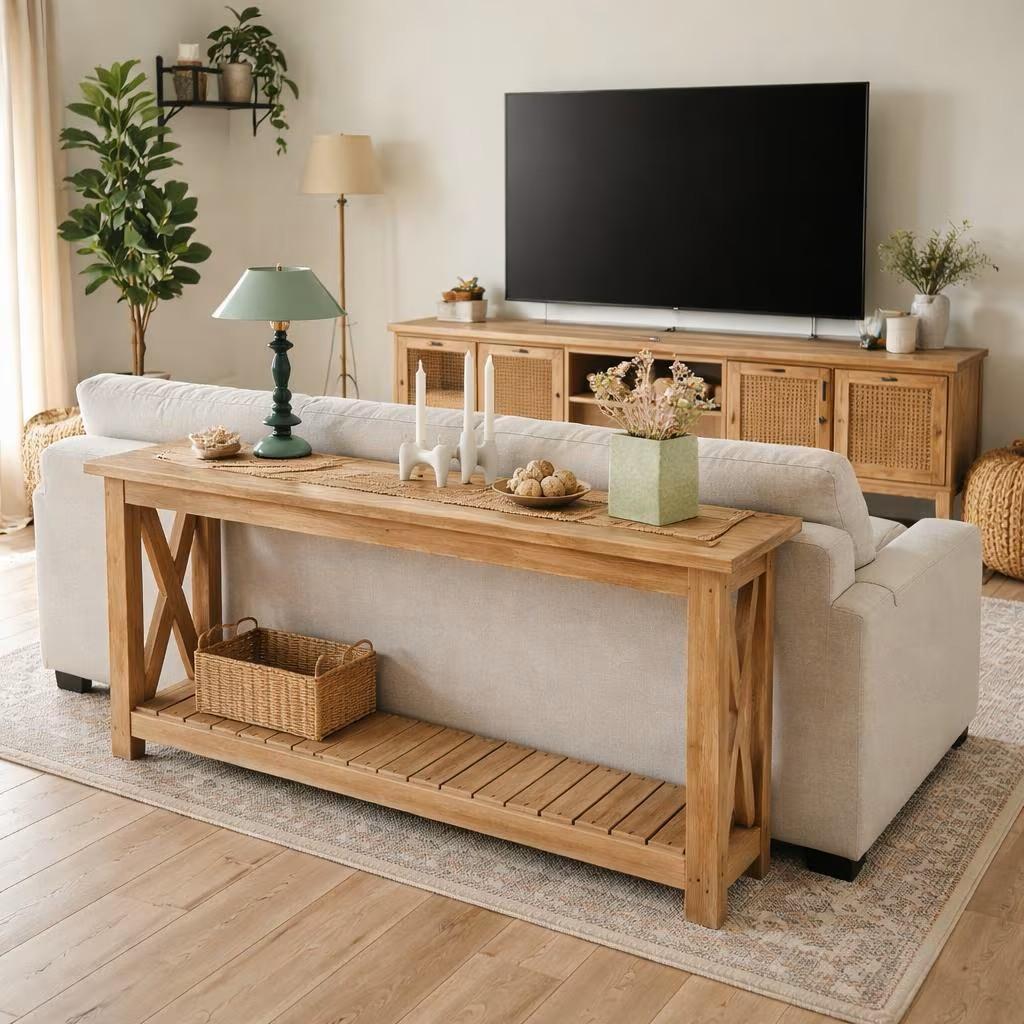
Design guidance commonly recommends that a behind‑sofa table sit at or just below the sofa’s back height so it reads as a cohesive unit and doesn’t block sightlines (Homes & Gardens). This makes lamps more usable and keeps proportions balanced. If you plan to place a table lamp on the table, choose a height that keeps the lamp shade at a comfortable reading height when seated — designers often leave the tabletop level equal to the sofa back or a little lower rather than significantly higher.
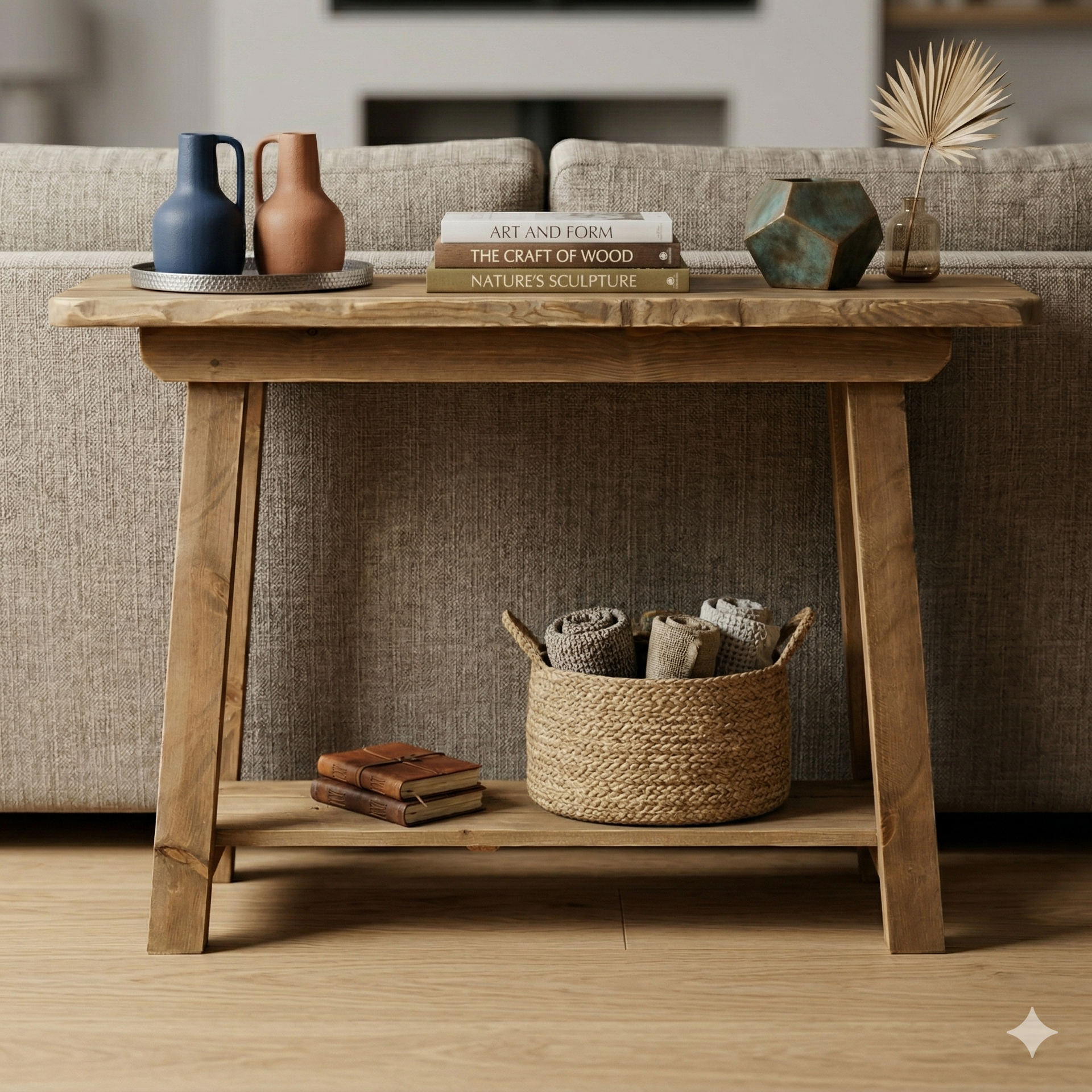
Wood and Loom product pages show an example behind‑couch table with an approximate height of 75 cm. Use that as a reference point when comparing to your sofa’s back height.
How long should the table be relative to your sofa?
A useful rule of thumb for behind‑sofa tables is that they should be substantial enough to look intentional: many designers suggest a table length that is roughly 60–80% of the sofa’s length (Pottery Barn, Architectural Digest, Homes & Gardens). This keeps the table visually balanced while leaving some sofa ends clear for armrests or side tables.
How deep should a behind‑sofa table be? (20 cm, 25 cm, 30 cm examples)
Depth choices depend on intended use and circulation constraints. Consider three practical depth bands:
- Approx. 20 cm (~8 in; very narrow): Good when clearance behind the sofa is tight or the table is primarily decorative — holds small objects, thin trays or a row of narrow vases. Homes & Gardens has shown viral slim console examples in this category.
- Approx. 25 cm (~10 in; slim but practical): A versatile compromise. Wood and Loom offers a 25 cm deep console option; this depth fits small lamps, a charging tray, books and low plants without jutting into walkways.
- Approx. 30 cm (~12 in; roomier): Useful if you want to place larger lamps, multiple decorative objects, or a charging station with room for devices and a tray. Wood and Loom product listings include photographed configurations with depths around this size.
Clearance and circulation — how much space to leave
Think about two clearances: the gap between the sofa back and the table, and the walking space behind the table (if the table sits in a circulation path). For the gap between sofa and table, many installations leave a small gap so cushions can sit comfortably (a visual gap of a few centimetres up to ~10–15 cm depending on cushion depth). For walkways you should allow a generous path: most interior-layout guidance recommends roughly 75–90 cm (30–36 in) for a primary circulation route so people can pass comfortably (Crate & Barrel, HouseBeautiful). If the table sits against a wall behind the sofa rather than in a traffic route, that larger walkway clearance can be reduced.
What you can realistically place on a behind‑sofa table
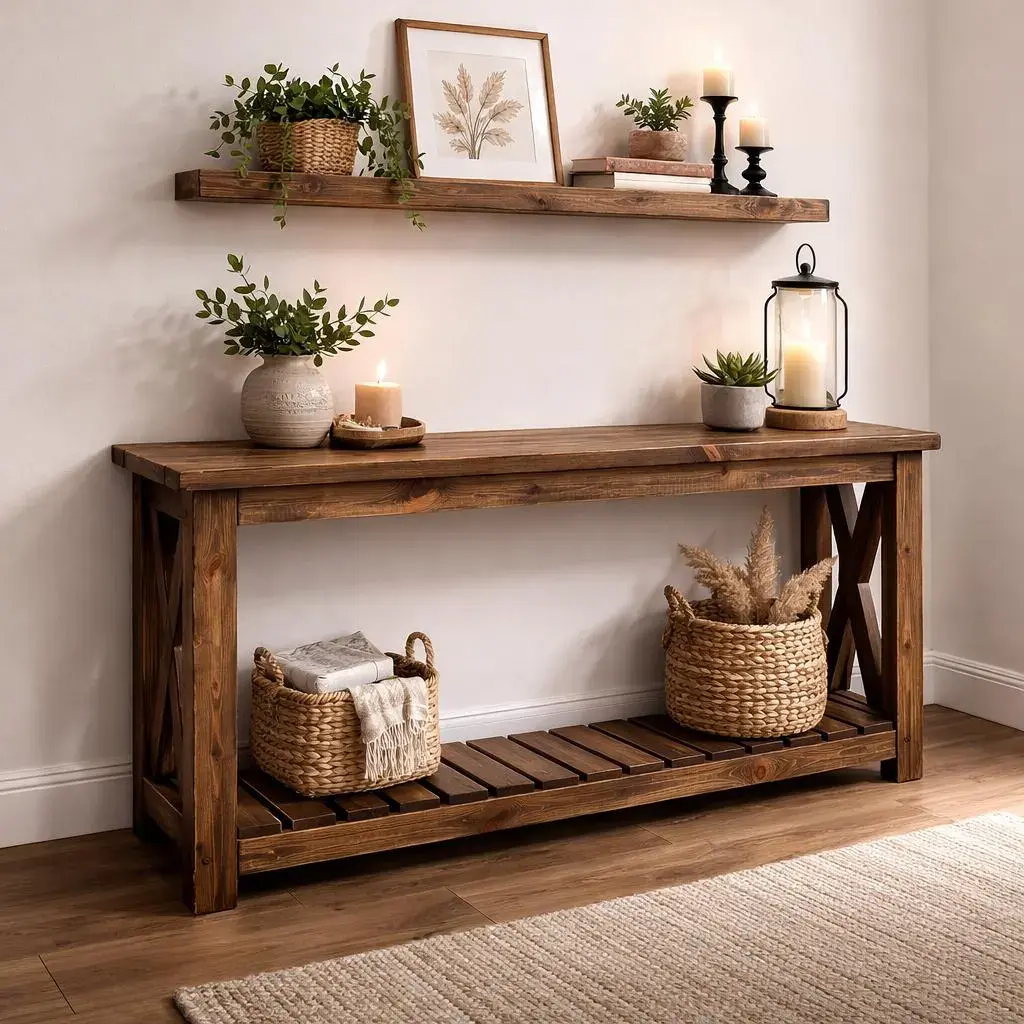
Common and practical items include lamps, compact charging trays, a small stack of books, plants, framed photos or low sculptures. Keep heavier or taller lamps in mind when planning depth and height so the base fits comfortably and the light sits at the right level for reading. If you plan to place multiple items, leave negative space — a single lamp plus one or two accessories keeps the surface from feeling crowded.
When to choose a custom size
Custom sizes are worth considering when you have an unusually short or long sofa, very tight or very generous circulation space, or a specific combination of lamp and accessories that requires non‑standard depth or height. Wood and Loom product pages note that many sofa and console pieces are made‑to‑order and customers are encouraged to request custom sizes; speak to a maker if you need exact matching to an existing piece or a precise depth for wiring.
Practical examples: recommended table lengths for common sofa widths
Using the 60–80% length guidance, here are example table length ranges you can test for common sofa widths. These are proportions; choose a value in the range based on whether you prefer a more fitted or more substantial look:
- Sofa 180 cm: table ~108–144 cm long (60–80%)
- Sofa 200 cm: table ~120–160 cm long
- Sofa 220 cm: table ~132–176 cm long
- Sofa 240 cm: table ~144–192 cm long
If you prefer the table to nearly span the sofa for a formal look, choose a length at the upper end of the suggested range; for a more minimal look, choose nearer the lower end. These are design rules of thumb rather than strict prescriptions (Pottery Barn, Architectural Digest).
How to measure your sofa and plan placement (simple checklist)
1) Measure the sofa’s overall length and the height of the back from the floor. 2) Decide whether the behind‑sofa table will sit in a traffic path (plan for 75–90 cm / 30–36 in of walking space) or against a wall (less walkway required). 3) Decide the table’s function (lamp and chargers, mainly decorative, extra storage). 4) Mock up the proportions with painter’s tape or a cardboard template to test depth and length before ordering.
Wood and Loom recommendations and product links
For shoppers who want made‑to‑order solid‑wood console or behind‑sofa tables, Wood and Loom’s sofa table category is a place to browse options. Example product pages include behind‑couch tables with example dimensions (for instance, an example behind‑couch table listing displays approximate dimensions of H ≈ 75 cm, D ≈ 30 cm and L 120 cm). There is also a 25 cm deep console product listed as a narrower option. If you need a custom length, Wood and Loom’s shop notes that customers should request bespoke sizes when required.
Summary and quick decision checklist
- Height: aim for tabletop level at or slightly below the sofa back for best proportion and usable lamp height.
- Length: target roughly 60–80% of sofa length; use the example ranges for 180–240 cm sofas above.
- Depth: choose 20 cm (~8 in) for very slim decorative tables, 25 cm (~10 in) for a practical narrow surface, 30 cm (~12 in) for more surface area and lamp room.
- Clearance: leave a small gap between sofa back and tabletop (a few centimetres up to ~10–15 cm) and plan 75–90 cm / 30–36 in if the table sits in a main walkway.
- Custom: consider custom sizing when sofas or pathways are non‑standard — Wood and Loom offers made‑to‑order pieces; request custom size details before ordering.
If you’d like help translating your measurements into a specific product, use the Wood and Loom sofa tables category to compare examples and request custom sizes where needed. Double‑check lamp heights, plug access and the intended load for heavier objects before finalising a depth and length.